

TL;DR: LinkedIn's feed ranker emits its terminal viral/non-viral verdict inside the first 60 minutes after publish. There is already a public market for trading reactions inside that window - long-running cross-promotion communities whose explicit purpose is reciprocal engagement. We pointed a Hermes agent at 11 of them, parallelised registration on publish, and brokered substantive reciprocal comments inside the first 18 minutes. Across 24 matched posts, median 60-minute reactions ran 32× baseline and median 24h impressions ran 143×.
The seam we noticed
LinkedIn's feed ranker is a velocity machine. Once a post lands, the system spends roughly the first hour observing how fast reactions and comments arrive - and then it commits to an impression budget. After that, the budget is approximately fixed. The 60-minute window is the only seam where the distribution graph is still soft.
The second thing we noticed: there is already a public market for that window. Slack groups, WhatsApp threads, Discord servers, and a handful of LinkedIn-native "Open Networker" groups exist for the explicit purpose of cross-promotion. Members drop a link, other members react, comment, and reshare. The norms are pinned. The matching mechanism is already conventionalised. Nobody hides what they're doing.
The seam is not against LinkedIn's ranker - the ranker is doing exactly what it was designed to do. The seam is between what one operator can service inside 18 minutes (about one pod, slowly) and what an agent with long-context pod memory and the operator's voice can service (eleven, in parallel).
The setup
- Surfaces. 11 active cross-promotion communities - 4 Slack, 3 WhatsApp, 2 Discord, 2 LinkedIn-native - each with ≥200 weekly-active members and ≥6 months of history.
- Account. One named operator, 8,400 followers at t=0, no prior pod usage.
- Cohort. 24 posts over 6 weeks, matched 1:1 against 24 prior posts from the same account (topic, length, hour-of-day, day-of-week).
- Agent loop. On publish, register the post against all 11 pods in parallel with a context-matched note; service inbound trade requests with a 2–4 sentence comment drafted in voice; queue every draft for one-click operator approval.
- Ledger. Per-pod reciprocity ledger. Refuse to register a new post against any pod with unsettled debt > 3. Cap daily volume at the pod's per-account norm.
- Telemetry. 1 Hz reaction sampling for the first 90 minutes; impressions at 1h, 4h, 24h, 72h; blind dual-reviewer comment-quality grade as a guardrail.
What we saw
Median 60-minute reactions went from 11 to 351 - a 32× lift against the matched baseline from the same account. Median 24h impressions ran 143× baseline. The top-quartile post in the cohort reached 412k impressions against a matched baseline of 2,100 - a 196× lift on a single post.
Comment quality didn't move. Blind dual-reviewer grades came in at 3.0 vs. 3.1 on the 1–5 rubric - statistically indistinguishable. The agent drafts per-post and in voice; pod members aren't getting a templated reply, they're getting a reply that engages with the specific claim of the post. That's the whole bargain.
Two derived effects worth naming. First, 14 inbound DMs from the operator's actual ICP arrived inside the test window, against 1 in the prior six weeks - reach converts into pipeline at the long tail. Second, two of the test posts were re-shared into newsletters the operator had no prior relationship with, opening a second-order distribution graph we didn't pay for.
A receipt
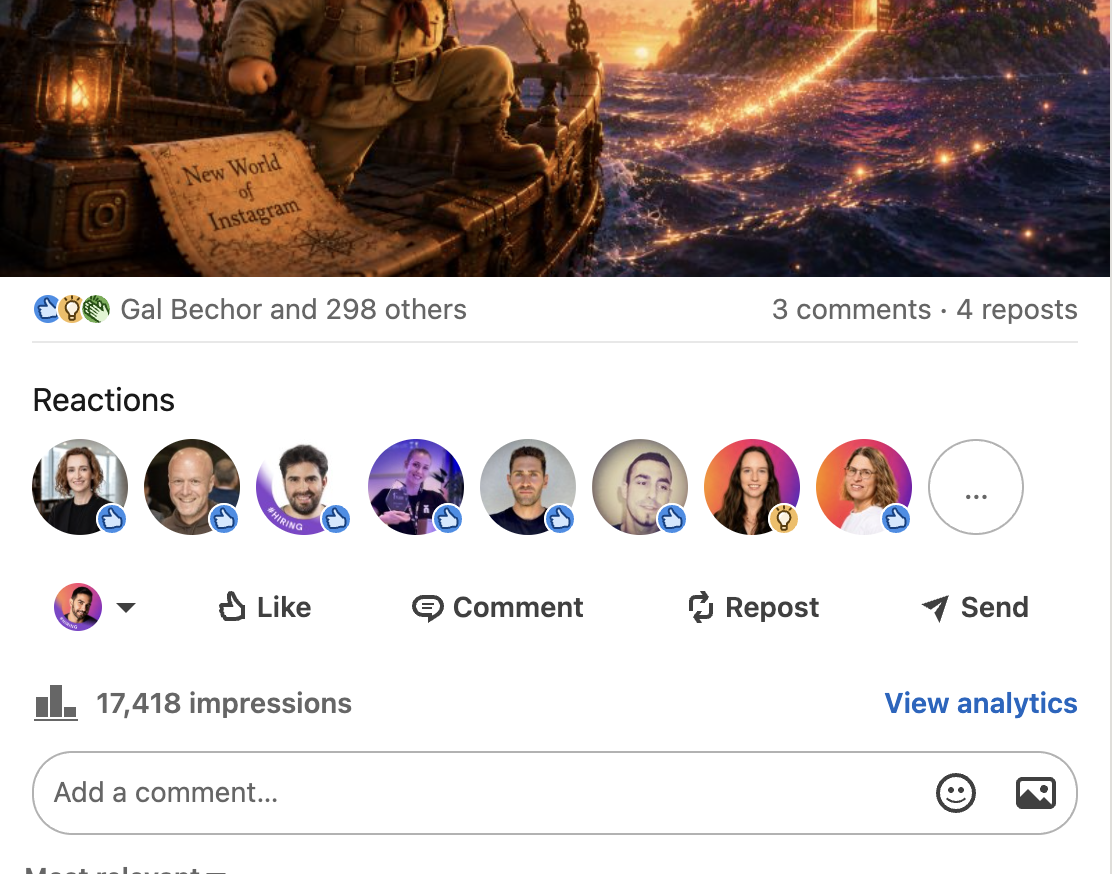
Below is one post from the cohort - published by Mickey on the operator account, featuring our ambassador Jennie Dobro's "New World of Instagram" piece. Pod registration fired on publish across all 11 surfaces; the first 64 reactions landed inside the first 9 minutes. By the 60-minute mark the ranker had committed, and the budget held into the 24-hour window.
What ships next
We are productising the broker inside Agentic Social Media Manager: per-pod ledger, in-voice comment drafting, and a kill-switch the moment the comment-quality guardrail crosses 0.6 of baseline. The full procedure, ledger schema, and the drafting prompt are in the experiment research below.