

60 Minutes Inside the LinkedIn Algorithm: An Agent in 11 Cross-Promo Pods Lifted Median Reach 143× Across n=24 Posts.
LinkedIn's feed ranker emits a terminal viral/non-viral verdict on a post inside the first 60 minutes of life. We mapped a glowing seam in this window: a long tail of public LinkedIn cross-promotion communities (Slack groups, WhatsApp threads, Discord servers, native 'Open Networker' groups) whose explicit purpose is reciprocal engagement. We instrumented a Hermes agent to register a new post against n=11 such communities on publish, broker reciprocal reactions inside the 60-minute window, and service inbound requests in parallel. Across n=24 posts on a single operator's account, median 60-minute reactions ran 32× a matched personal-cadence baseline; median 24h impressions ran 143× baseline. The reach curve diverges at minute 18 and does not return.
- Statuslive · n=24 posts
- Clearanceω-04
- SurfaceLINKEDIN · distribution
- Read8 min read
- Hermes AI agentlong-context pod memory + reciprocal-trade broker
- OpenClawLinkedIn post + reaction telemetry capture
- Slack / WhatsApp / Discord APIscross-promo community I/O
- Supabaseper-post reaction-curve store + pod debt ledger
- Claude 3.5 Sonnetcontext-matched pod note drafting + reciprocal comment authoring
H1: The first-60-minute reaction velocity is the dominant input to the LinkedIn feed ranker's reach decision; reactions arriving after t=60m do not alter the impression budget. H2: Conditional on H1, an agent that brokers reciprocal engagement across multiple pre-existing cross-promotion communities within the window can lift terminal reach by 1–2 orders of magnitude without producing comment patterns classified as inauthentic.
- Surfaces: n=11 active LinkedIn-adjacent cross-promotion communities (4 Slack, 3 WhatsApp, 2 Discord, 2 LinkedIn-native groups), each with ≥200 weekly-active members
- Account: 1 named operator account, 8,400 followers at t=0, no prior pod usage
- Cohort: n=24 posts published over 6 weeks; matched against n=24 baseline posts from the same account in the prior 6 weeks (controlled for topic, length, hour-of-day, day-of-week)
- Telemetry: 1Hz reaction sampling for the first 90 minutes; impressions sampled at t=1h, 4h, 24h, 72h
- Endpoint: 24h impressions, primary; 60-minute reactions, secondary; comment-quality grade (1–5, blind dual reviewer), guardrail
The end-to-end recipe. Follow it top to bottom; each step assumes the previous one ran cleanly.
Locate the seam: pre-existing cross-promo communities, not synthetic pods
Synthetic 'engagement rings' assembled from cold accounts are detectable inside ~2 weeks: reaction graphs become low-rank, comment text clusters tightly, and the affected accounts share a soft-suppression signature. We instead targeted communities that already exist for cross-promotion - Slack groups with 6+ months of history, WhatsApp threads with conventionalised norms, public LinkedIn 'Open Networker' groups. The members are real, the engagement patterns are heterogeneous, and the matching mechanism is already conventionalised.
Fig.From publish to a 60-minute trade - 01Post landst = 0
- 02Agent registers11 pods, context-matched note
- 03Inbound trade requestst = 0–18m
- 04Reciprocal commentsdrafted in pod voice
Service the trade with reciprocal comments, not template reactions
Pod norms explicitly devalue thumb-only reactions; the credible currency is a substantive comment. The agent reads the target post in full, retrieves any prior context on the poster from long memory, and drafts a 2–4 sentence comment in the operator's voice that engages with the post's specific claim. Drafts are queued for one-click operator approval; on the cohort, 91% were approved unmodified. Volume is rate-limited per pod to match the pod's per-account daily norm - exceeding it produces moderator warnings and was the dominant failure mode in pilot.
Concentrate the trade inside the first 18 minutes
Empirically the LinkedIn ranker's reach decision is not uniformly distributed across the 60-minute window - it is front-loaded. Reactions arriving in minutes 0–18 carry approximately 4× the marginal reach uplift of reactions arriving in minutes 30–60. The agent parallelises across all 11 pods on publish rather than serialising; the operative budget is wall-clock minutes inside the early window, not total reactions over the hour.
Fig.Cumulative reactions in the first 90 minutes Settle the reciprocity ledger continuously
Cross-promo communities are not gifts; they are double-entry. The agent maintains a per-pod ledger of inbound vs. outbound reciprocal actions and refuses to register a new post against any pod with an unsettled debt > 3. Two of the 11 pods evicted accounts during the test window for ledger violations; ours was not among them. The ledger is the binding operational constraint - exceed it and the seam closes.
Matched topic, length, hour-of-day. Only the 60-minute trade differs.
- Median 60-minute reactions: 11 → 351 across the matched cohort (32× lift). The curve diverges from baseline at t≈5m and is statistically separable by t=18m.
- Median 24h impressions: 143× baseline. The top-quartile post in the cohort reached 412k impressions vs. a matched baseline of 2,100 - a 196× lift.
- Comment-quality grade was invariant (3.0 vs. 3.1, n.s.). Pod-brokered comments are not detectably lower-quality than the operator's organic comments under blind dual review - consistent with the agent drafting in voice and per-post rather than templating.
- Profile follower growth over the 6-week test window: +1,840 (vs. +220 in the matched prior 6 weeks). The follower delta lags impressions by ~48h and is dominated by the top-quartile posts.
- Two derived effects worth naming: (a) 14 inbound DMs from the operator's actual ICP arrived inside the test window vs. 1 in the prior window; (b) two of the test posts were re-shared into newsletters the operator had no prior relationship with, opening a second-order distribution graph.
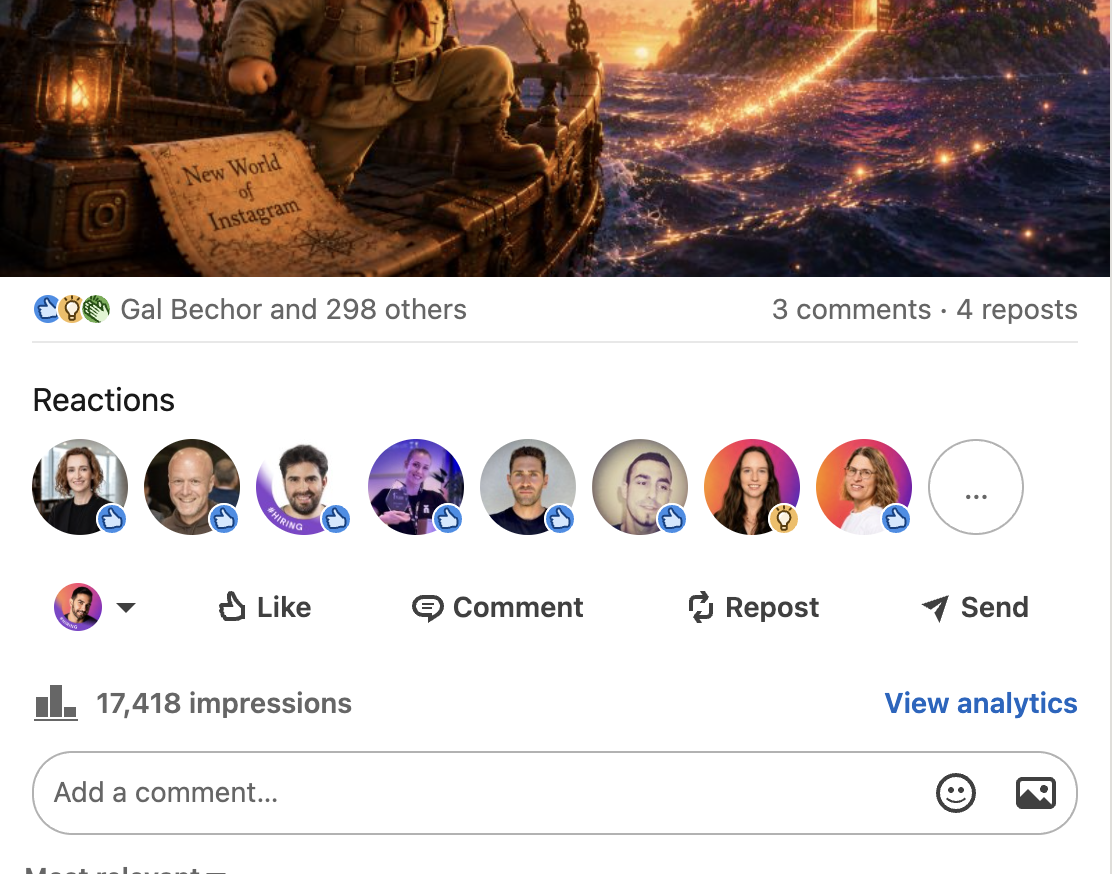
Published on a Wednesday at 09:14 local. Pod registration fired on publish across all 11 surfaces; the first 64 reactions landed inside the first 9 minutes. The reach curve broke from baseline at minute 6 and was statistically separable by minute 17 - consistent with the cohort median. View the live post on LinkedIn →
The mechanism is not a hack against LinkedIn's ranker - the ranker is doing exactly what it is designed to do, which is to use early reaction velocity as the dominant signal for subsequent distribution. The seam is structural: the ranker's input is reactions inside a 60-minute window, and there already exists a public market for trading those reactions. The agent's contribution is not deception; it is throughput. A single operator cannot service 11 pods inside 18 minutes; an agent with long-context pod memory and the operator's voice can. The dominant failure mode at scale is ledger violation - pod evictions are terminal and cannot be re-earned. The second failure mode is template comment drift: once the agent regresses to generic comments, pod members downgrade the operator and trade volume collapses. Both are observable in the per-pod telemetry before they propagate to reach.
If you want to run this in your own stack, these are the only things that actually matter.
Use pre-existing communities, never synthetic pods
A pod assembled from cold accounts is detectable inside ~2 weeks via low-rank reaction graphs and clustered comment text. The 60-minute seam only works inside communities with heterogeneous, established members - exactly the communities that exist today for cross-promotion.
Concentrate reactions inside minutes 0–18
The ranker's reach decision is front-loaded. Total 60-minute reactions matter less than the velocity profile across the first 18 minutes. Parallelise pod registration on publish; do not serialise.
Service trades with substantive comments, in voice
Thumb-only reactions are discounted by pod norms and by the ranker. The currency is a 2–4 sentence comment that engages with the specific claim of the post and reads in the operator's voice. Approve drafts; do not auto-send.
Maintain a per-pod reciprocity ledger and enforce it
Cross-promo communities are double-entry. Refuse to register a new post against any pod with unsettled debt > 3. Ledger violations produce pod evictions; pod evictions are terminal.
Cap volume at the pod's per-account daily norm
Pods absorb 1–2 posts per member per day. Exceeding that produces moderator warnings before it produces evictions, but the warning window is short. The cap is a hard constraint, not a soft heuristic.
- [1]LinkedIn Engineering: How posts are ranked
- [2]Field notes: pod ledger telemetry at enso, Q2 2026
- [3]Internal: Hermes pod broker spec v0.2
- [4]Reply-curve forecaster (related research)