
TL;DR: Outbound is usually written as a cadence - a list of channels and the days you touch them. We rebuilt ours as a state machine. One prospect can receive up to 27 touches across email, LinkedIn, SMS and voice, in Hebrew or English, with colleague escalation, open-triggered nudges, provider failure rerouting and a capped nurture drip after a polite no. Roughly four fifths of it fires on conditions rather than dates. A person designs the sequence once. The agent plays it perfectly, per prospect, forever.
The reason this matters is not the volume. It is that the SDR job is no longer one job. The strategic side - researching what pain to name, what evidence to cite, what sequence should follow - is still human. The execution side - watching 200 state machines at once, reacting within the hour, never forgetting - finally belongs to an agent. This is the first time that combination has been cheap enough to run at scale.
The SDR job is splitting in two
For a decade the SDR was measured on output. Calls made, emails sent, meetings booked. The best reps were the ones who could remember the most details and say the same script with enough variation to sound like a real person. The whole role was built around one assumption: a single person can hold a few dozen prospects in their head at once.
That assumption is now the bottleneck. The data you need to make a cold email relevant - a recent funding round, a new hire, a competitor campaign, a product launch, a job post that names a problem, a LinkedIn post venting about a vendor - is all available. But one person cannot read all of it for 200 prospects and still write before the signal goes cold.
So the SDR splits into two roles.
- The researcher. The person who knows what pain to name, what signal to look for, what evidence to cite, and which sequence should follow. They design the negative rules: never restart after a no, never text someone who replied, never comment twice inside five days.
- The state machine. The system that watches every prospect's state, reacts within the hour, and never slips. It holds cadence day, open count, colleagues contacted, comment cooldown, number routability, and the last reply tone - for every prospect at once.
The old SDR memorized a pitch and worked a list. The new SDR designs a research system that reads signals most reps never see, then lets the agent execute the state machine. The job is no longer the 100 calls a day. The job is knowing which pain to name, and when.
| Old SDR | New SDR |
|---|---|
| "I have a list of 100 leads and a pitch. I call until somebody says yes." | "I have a set of signals. If a company shows signal X, I cite evidence Y and ask question Z. The agent handles the 27 follow-up conditions." |
| "I sent 50 emails today." | "I designed one sequence that adapts to what the prospect actually does." |
| "I got lucky and caught them at the right moment." | "The agent caught the moment. I reviewed the result and tightened the rule." |
In the future the SDR is not a junior seller. They are a researcher, a prompt designer, and a quality controller. They listen to what the market is saying in public signals, translate that into a sequence, then audit the replies and adjust. The dialing is gone. The judgment is not.
Why personalized pain research is possible now
This is the first time in history that a company can research a unique pain for every prospect at scale. Three things changed at once.
Signal abundance. Every company leaves traces. LinkedIn posts, job listings, website copy changes, funding announcements, G2 reviews, podcast appearances, open roles, competitor moves. The traces were always there. They were just too scattered to read before they aged out.
Cheap intelligence. A large language model can read a prospect's LinkedIn profile, company website, and a recent news article in seconds, then infer what the company is likely struggling with. That inference used to cost a researcher hours. It now costs cents and happens at three in the morning.
Persistent state. A traditional SDR forgets. The next SDR inherits notes that are incomplete. An agent remembers every open, every reply, every colleague CC'd, every comment cooldown, every failed SMS. It holds the entire state for every prospect at once, and it never confuses two people.
Put those three together and you can do something that was impossible before: send outreach that feels like it was written by one person who has been watching this company for weeks, to every prospect, every day, without the person.
The inbox is a castle most people bounce off. We found the glowing crack: the moment a prospect's own behavior changes what they should receive next. A fifth open, a silent reply window, a colleague who got CC'd, a provider failure - each is a signal that the next message should be different. The crack is not a trick. It is the attention that leaks out when the message finally matches the moment.
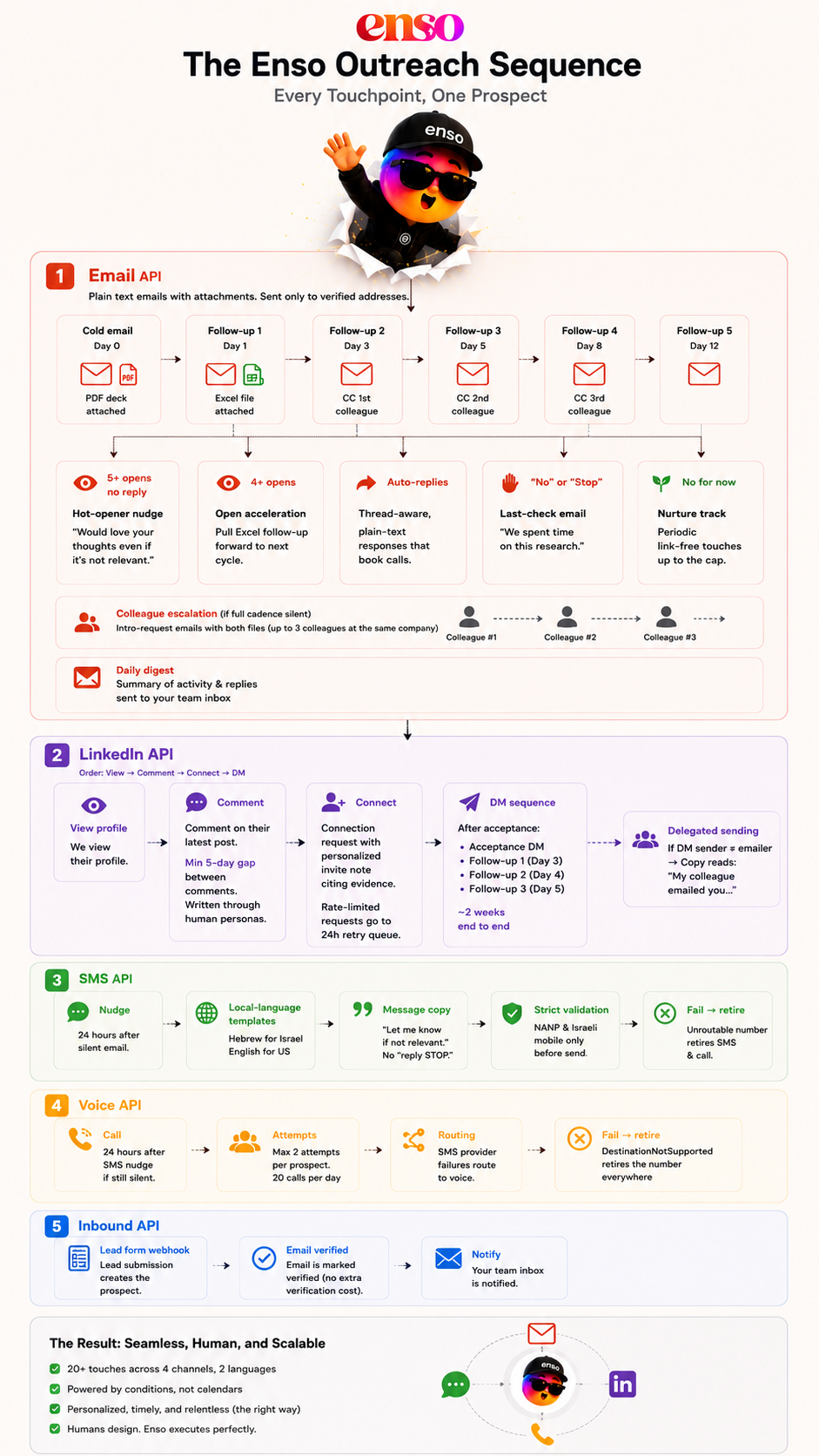
1. Email (AgentMail)
The cold email is plain text, no tracking pixel, de-promoted copy, PDF deck attached. It only goes out after Hunter verifies the address, because every open-count rule downstream is worthless if the base deliverability is noisy.
- Follow-ups on days 1, 3, 5, 8 and 12. The first one attaches the Excel workbook. Later ones CC a colleague at the same company.
- Colleague escalation. If the full cadence goes silent, the sequence hands off to a colleague - up to three people per company - with an intro-request email carrying both files.
- Hot-opener nudge. Five or more opens with no reply triggers an out-of-sequence note: "would love your thoughts even if it's not relevant."
- Open acceleration. Four or more opens pulls the Excel follow-up forward to the next cycle instead of waiting out the calendar.
- Auto-replies. Inbound replies get a thread-aware, plain-text response that books calls.
- Last-check email. A "no" or "stop" gets one final "we spent time on this research" email, and nothing more from the main sequence.
- Nurture track. "No for now" prospects receive periodic link-free touches up to the nurture cap. The main sequence never restarts.
- Daily digest to one human reviewer at mickey@enso.bot.
2. LinkedIn (Unipile)
Order matters: view → comment → connect → DM. Reversed, it reads as a bot that found a list. In order, it reads as somebody who has been circling your work for a week.
- View the profile. The cheapest signal there is, and the one most sequences skip.
- Comment on their most recent post. Minimum five-day gap between comments, written through a 12-lever human persona, in Hebrew for Israeli founders.
- Connection request with an invite note that cites evidence. Rate-limited requests go to a 24-hour retry queue.
- DM sequence after acceptance. One acceptance DM, then three follow-ups at three, four and five-day intervals. About two weeks end to end.
- Delegated sending. When the DM sender is a different person than the emailer, the copy reads "My colleague [Name] emailed you...".
3. SMS (Saperly)
- A nudge 24 hours after a silent email, not on a fixed day.
- Local-language templates: Hebrew for Israel, English for the US.
- The copy says "let me know if not relevant." No "reply STOP".
- Strict destination validation (NANP and Israeli mobile only) before dispatch. An unroutable number retires both text and call.
4. Voice (Saperly)
- Call 24 hours after the SMS nudge if the prospect is still silent.
- Maximum two attempts per prospect, 20 calls per day across the pipeline.
- SMS provider failures route to voice. A DestinationNotSupported response retires the number everywhere.
5. Inbound
A LinkedIn Ads lead-form webhook creates the prospect, marks the email verified so no Hunter spend is incurred, and pings the reviewer. Inbound and outbound then share one state model, which is what stops the classic embarrassment of texting somebody who filled in your form an hour ago.
Manual SDR vs agentic SDR, on the same list
We ran the same 400-account list twice: once through a two-person SDR pod working normal hours, once through the sequence above. Same copy foundations, same offer, same 21-day window. The interesting gap is not effort. It is what happens in the hours nobody is watching.
Each pair is scaled to its own group. The pod was not lazy - it ran out of hours, not intent.
Errors here means the unforgivable kind: a text to somebody who already replied, a comment two days after the last one, a main-sequence restart on a prospect who said no. The pod made fourteen of them per hundred prospects, which is what happens when a few thousand facts live in a spreadsheet.
A fourth open at 02:40 is worth the same as one at 14:00. Only one of the two operators believes that.
The lift is not better writing. It is the same writing arriving while the prospect is still in the tab.
Why only an agent can run this
Count what one prospect can receive: six emails, three more to their colleagues, a nudge when they open five times without answering, a profile view, a comment on their latest post, a connection request, four DMs, a text, two phone calls, and a slow drip of nurture touches after a polite no. More than twenty touches, across four channels, in two languages.
An SDR could do that. For one prospect. Maybe five.
Here is the part that breaks a human. Almost nothing in this sequence runs on a calendar. It runs on conditions:
| Condition | What fires |
|---|---|
| 4 opens | Pull the Excel follow-up forward. |
| 5 opens, zero replies | Send the off-script nudge. |
| Email silent 24 hours | Text them, in their language. |
| Text silent 24 hours | Call. |
| SMS provider fails | Reroute to voice. Voice fails too, retire the number everywhere. |
| LinkedIn rate limit | Queue the invite and retry tomorrow. |
| Second comment on their feed | Only if five days passed since the first. |
| Whole cadence dead | Ask their colleague for an intro. Then a second. Then a third. |
| They said no | One last email, then the nurture track. Never restart the main sequence. |
A calendar you can manage in a spreadsheet. Conditions you have to watch. Every prospect sits in their own state: which day of the cadence, how many opens, which colleague got CC'd, whether the phone number is even routable, whether the comment cooldown expired. Run 200 prospects and you are tracking a few thousand of these facts, all changing hourly, where one slip means texting someone who replied yesterday or restarting a sequence on someone who said stop.
Humans are good at writing the message. Humans are terrible at being awake at the exact moment the fourth open happens.
So the honest division of labor: a person designs the sequence once. The agent then plays it perfectly, per prospect, at whatever count the pipeline holds, and reacts within the hour instead of at the next coffee-fueled inbox review. The prospect on the other side experiences something strange: outreach that behaves like a single, patient, unusually attentive human. Which is the whole trick. The scale is invisible. Only the attention shows.
If you want to run it
Start with the negative rules, not the touches. Never restart after a no. Never text somebody who replied. Never comment twice inside five days. Then give every prospect their own record - cadence day, open count, colleagues contacted, comment cooldown, number routability - and let the conditions, not the calendar, decide what happens next.
The real advantage is not the number of touches. It is that the sequence can respond to what the prospect actually does, because the agent is reading the same signals a great SDR would read, at a scale and speed no great SDR can match. That is the future of the role: not more noise, but the right message at the moment the prospect's own behavior says they are ready to hear it.